The Library of Clarity · Experimentation & CRO
Experimentation Strategy: A/B Testing vs. Multi-Armed Bandits
How to choose the right testing method for learning, optimization, ecommerce, product decisions, and measurable growth.
The core decision: use A/B testing when the priority is learning with clear, controlled evidence. Use a multi-armed bandit when the priority is optimizing performance while the experiment is still running.
Why the distinction matters
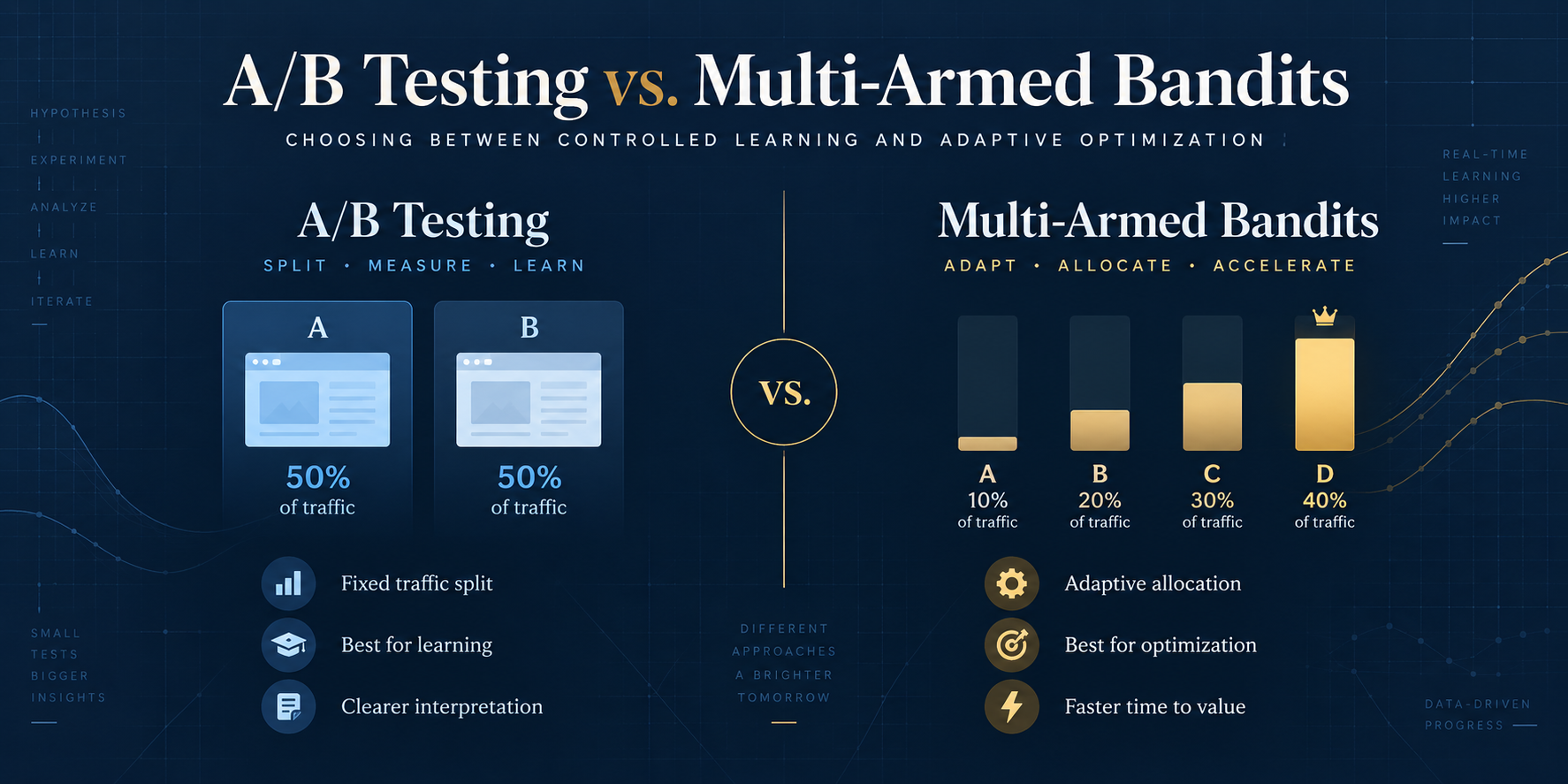
A/B testing and multi-armed bandit experimentation both compare alternatives, but they solve different business problems. Traditional A/B tests hold traffic allocation relatively steady so teams can evaluate differences under controlled conditions. Multi-armed bandit approaches adapt traffic allocation over time, sending more visitors toward better-performing options as evidence accumulates.
The right choice depends on the decision you need to make, the amount of traffic available, the duration of the opportunity, the technical resources involved, and how much interpretability you need from the result.
Quick comparison
Best for learning
Traffic is divided between a control and a variant while performance is measured against a predefined metric.
- Simple to design and explain
- Clearer statistical interpretation
- Strong control over variables
- Useful for durable, high-impact decisions
Tradeoff: slower optimization and continued exposure to underperforming variants during the test.
Best for optimizing
Traffic is dynamically reallocated toward stronger-performing variants as the algorithm learns.
- Optimizes while the test runs
- Faster time to value
- Supports multiple variants
- Well suited to time-sensitive opportunities
Tradeoff: greater technical complexity and less straightforward interpretation.
How the methods differ
| Decision factor | A/B testing | Multi-armed bandit |
|---|---|---|
| Primary objective | Learn which version performs better under controlled conditions | Maximize performance during the experiment |
| Traffic allocation | Usually fixed or evenly divided | Dynamically adjusted based on performance |
| Speed | Requires enough time and sample size to evaluate | Can shift traffic toward stronger variants earlier |
| Interpretability | Clearer and easier to explain | More complex because allocation changes over time |
| Complexity | Relatively simple to implement | Requires more advanced algorithms and monitoring |
| Best use cases | Long-term UX, messaging, pricing, layout, or product decisions | Short promotions, ecommerce optimization, ads, recommendations, and multiple variants |
When to use A/B testing
- Long-term decisions: website redesigns, navigation changes, pricing presentation, onboarding flows, or durable messaging changes.
- Behavioral learning: when the organization needs to understand why one experience performs differently.
- Low-risk environments: when temporary exposure to a weaker variant has limited business impact.
- Governance and explainability: when leaders need a clearly documented result and a repeatable decision trail.
When to use a multi-armed bandit
- Time-sensitive promotions: flash sales, event registrations, limited inventory, or rapidly changing campaign windows.
- Ecommerce optimization: product recommendations, offers, banners, and merchandising experiences where ongoing conversion matters.
- High-traffic environments: where the algorithm receives enough interactions to learn and adapt.
- Multiple variants: when several creatives, headlines, messages, or offers must be evaluated simultaneously.
Where Machine Learning Fits: Contextual Bandits and Adaptive Personalization
A multi-armed bandit is already an online-learning framework. Its algorithm selects among options, observes feedback, and updates future decisions. Machine learning is not simply an extra feature added to a static test. The central challenge is learning while acting under uncertainty, as explained in Microsoft Research’s introduction to bandit learning.
Standard bandit: optimize across an audience
Which option looks most promising overall?
A non-contextual bandit adjusts its choices using the observed rewards and uncertainty for each option, without conditioning those choices on the current user’s characteristics.
Contextual bandit: adapt to the situation
Which option looks most promising in this context?
A contextual bandit also uses information available before the decision, such as prior product activity, onboarding progress, device, or characteristics of the available content. Different options can be favored in different situations.
The learned selection rule is called a policy. Contextual learning does not inherently require deep learning: LinUCB, for example, uses linear models to connect context with expected reward. Li, Chu, Langford, and Schapire’s contextual-bandit research explains both this modeling approach and the distinction from context-free allocation.
How the learning loop works
Observe context → choose an eligible action → observe its outcome → update the policy.
The system normally receives feedback only for the option it chose—not the outcomes that would have occurred for the alternatives. That partial feedback makes exploration essential; a prediction of likely performance alone does not reveal what an untried option would have achieved. See Vowpal Wabbit’s contextual-bandit documentation.
Exploration means trying uncertain options to learn more. Exploitation means choosing options that currently appear promising. Allocating everything to an early apparent winner can leave better alternatives undiscovered. This exploration–exploitation tradeoff is the learning mechanism behind adaptive allocation—not simply an instruction to send more traffic to yesterday’s leader.
A hypothetical Marketing Operations example
Illustrative design only—not a claim that a previous client project used contextual-bandit learning.
Imagine an onboarding program choosing one of three eligible messages: a quick-start guide, a tutorial, or an invitation to a training session. A standard bandit could favor whichever message produces the most activation overall. A contextual bandit could learn whether a tutorial is more useful for people who started setup but stalled, while another message works better for people at a different stage. Those are hypotheses to learn from outcomes, not predetermined rules or promised results.
Use information known before sending: setup progress, prior product activity, and time since signup.
Choose among approved messages after applying eligibility, suppression, and contact-frequency rules.
For this example, measure a defined activation event within seven days of the selected message.
Rules-based automation: when a condition occurs, send a specified message.
Contextual-bandit learning: given the situation, choose among permitted messages, observe the outcome, and update future choices. The learning operates within the rules; it does not replace them.
Implementation controls matter as much as the algorithm
For a production onboarding program, I would require three operational foundations:
- A meaningful reward and an explicit observation window. In this example, activation is the goal; clicks are a supporting diagnostic. Keep outcomes pending until the agreed window closes rather than treating every not-yet-observed activation as a failure. Delayed feedback can destabilize bandit learning, as shown in Apple’s research on sequential optimization with delayed feedback.
- A decision log that supports evaluation. Record the context, eligible choices, selected action, its selection probability, policy version, and outcome timestamps. Action probabilities are important for evaluating adaptively collected feedback; Vowpal Wabbit documents context, action, probability, and reward as core components. Preserve a randomized baseline when the business needs an incremental-impact comparison.
- Human-defined boundaries and a fallback. Approve messages and features, enforce suppression and frequency limits, monitor missing or delayed events, and define pause and rollback conditions. Start with a narrow use case and compare it with a simpler workflow before expanding.
Potential benefit—not a guarantee: adaptive allocation can improve performance while learning, but it is not automatically faster or better than a well-designed A/B test. Traffic, reward delays, changing behavior, and implementation quality affect whether it is useful. The percentages in the feature graphic are illustrative allocations, not measured results or fixed algorithm settings.
A practical decision framework
Choose A/B testing when the main goal is controlled evidence, interpretability, and a durable decision.
Choose a multi-armed bandit when the opportunity is time-sensitive and adaptive allocation has greater value.
Long-term insight or immediate optimization?
Is there enough volume for the method to learn reliably?
Does the team have the technical expertise to implement and monitor it?
What is the cost of exposing visitors to an underperforming option?
Is the opportunity evergreen or constrained by a short window?
How important is a simple, explainable final result?
Common marketing applications
| Use case | Usually stronger fit | Why |
|---|---|---|
| Email subject lines | A/B testing; MAB when highly time-sensitive | Subject lines are easy to isolate, but short send windows may favor adaptive allocation. |
| Landing page conversion | A/B testing | Useful when the organization needs a clear decision about a lasting page experience. |
| Flash sales and short promotions | Multi-armed bandit | The value comes from shifting traffic quickly before the opportunity ends. |
| High-traffic apps | Either | Use A/B for learning and MAB for continuous optimization. |
| Long-term UX decisions | A/B testing | Interpretability and controlled learning generally matter more than short-term optimization. |
| Ad creative rotation | Multi-armed bandit | Adaptive systems can allocate more impressions or budget to stronger creatives. |
Common mistakes
- Running a test without one clearly defined primary metric.
- Stopping an A/B test as soon as one variant appears ahead.
- Using a bandit when the organization actually needs causal learning and interpretability.
- Ignoring traffic volume, seasonality, novelty effects, and changing audience behavior.
- Optimizing clicks when the business decision depends on revenue, retention, or customer quality.
- Failing to document the hypothesis, audience, variants, allocation logic, and final decision.
Experimentation checklist
- Define the business decision the experiment must support.
- Select one primary success metric and necessary guardrails.
- Confirm traffic volume, duration, and technical feasibility.
- Choose A/B testing for controlled learning or MAB for adaptive optimization.
- Document the hypothesis, audience, variants, and allocation method.
- Monitor data quality and operational issues while the test runs.
- Evaluate the result in business context—not only statistical or algorithmic output.
- Record the learning and the final implementation decision.
Where multivariate testing fits
Multivariate testing evaluates combinations of multiple page elements, such as headlines, calls to action, imagery, pricing presentation, and layout. A bandit approach can complement multivariate experimentation by dynamically allocating traffic toward promising combinations. This can be useful on high-traffic, information-dense experiences, but it increases implementation complexity and can make individual element effects harder to isolate.
Continue exploring experimentation and conversion strategy
This guide is part of the Library of Clarity. Explore related work and practical frameworks across CRO, analytics, data, and digital operating systems.
Explore the Library of ClarityRelated Library resources
About Kate Khoury
Kate helps organizations build clarity across Revenue Operations, Marketing Operations, Analytics, AI, and Digital Strategy. She specializes in designing systems that reduce complexity, improve decision-making, and create measurable business impact.
“I help organizations create lasting clarity, stronger alignment, and systems that continue delivering value as they grow.”
See this in practice
Experiment design is most useful when it is connected to a real decision and measurement plan.
See how experimentation fits into the broader operating model in A CRO Operating System, Optimizing the Free Trial User Journey, and Campaign Measurement & Attribution Governance.