The Library of Clarity · AI & Data Leadership
AI Accelerates Data Work. Human Judgment Makes It Valuable.
The strongest data teams use AI to increase speed and capacity while preserving the context, scrutiny, communication, and accountability that responsible decisions require.
By Kate Khoury · Leadership guide · Analytics & AI
Explore the framework / See it in practice / Use the checklist

AI can accelerate the process. It cannot own the decision. Value is created when automation is paired with clear objectives, reliable data, thoughtful validation, ethical judgment, and communication that fits the audience.
AI creates leverage across the data lifecycle
AI is increasingly useful in the work that surrounds analysis—not only in modeling. It can help teams research a business problem, clean and structure data, generate or troubleshoot code, identify patterns, summarize findings, propose visualizations, document logic, and translate technical work for different audiences.
That leverage matters. Data professionals often lose time to repetitive preparation, fragmented documentation, manual report building, and the cognitive cost of moving between technical and business contexts. AI can reduce that friction and expand the range of work one person or team can complete.
Research and synthesis
Summarize unfamiliar domains, compare approaches, surface assumptions, and organize background information before analysis begins.
Data preparation
Draft cleaning logic, identify missing values and duplicates, standardize formats, and document transformations for review.
Coding and analysis
Generate starter SQL, Python, DAX, or Power Query logic; troubleshoot errors; and suggest analytical methods.
Pattern discovery
Help explore large datasets, propose segmentation, flag anomalies, and generate hypotheses that deserve deeper investigation.
Communication
Draft executive summaries, presentation structures, chart titles, documentation, and audience-specific explanations.
Iteration and optimization
Compare options, incorporate feedback, refine workflows, and help teams move from a first draft to a stronger final output.
Human judgment is the operating system
The risk is not using AI. The risk is using it without a disciplined human layer.
AI systems can produce polished answers that are incomplete, biased, poorly framed, or factually wrong. They do not understand an organization’s history, political context, customer commitments, risk tolerance, or unspoken constraints unless a human provides that context—and even then, the output still requires review.
Frame the right question
A precise answer to the wrong business question is still a poor outcome. Humans define what matters and why.
Navigate ambiguity
Real organizations contain exceptions, incomplete information, competing priorities, and changing definitions.
Evaluate quality and bias
Humans must test assumptions, inspect limitations, protect sensitive information, and assess whether the data represents reality fairly.
Interpret context
Correlation, anomaly, and prediction are not the same as meaning. Experience connects analytical output to business conditions.
Communicate with nuance
Stakeholders need different levels of detail. Leaders translate complexity without hiding uncertainty or overstating confidence.
Own the decision
Accountability cannot be delegated to a model. People remain responsible for the action, consequences, and follow-through.
Human-in-the-loop framework
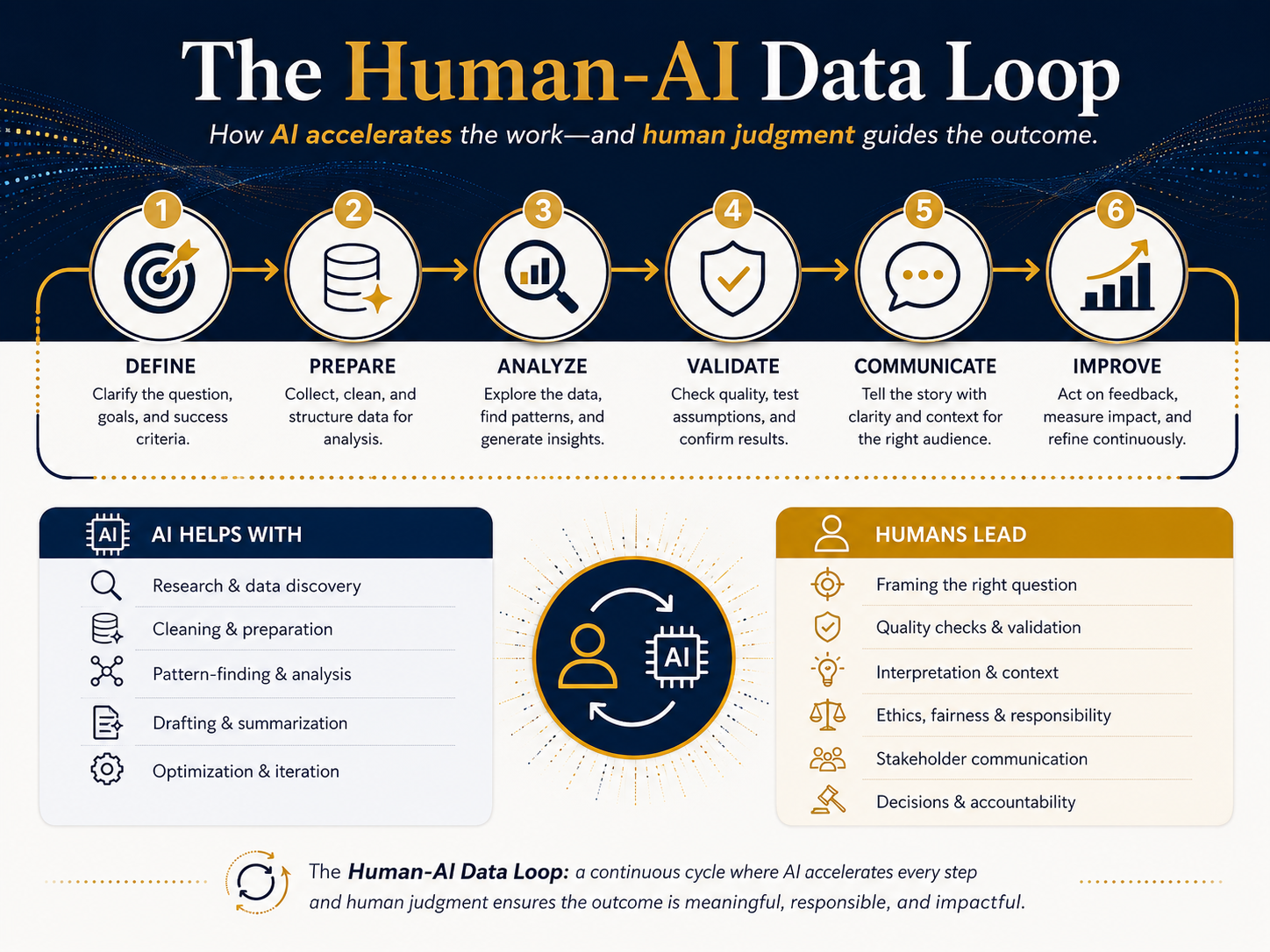
The Human–AI Data Loop
Define → Prepare → Analyze → Validate → Communicate → Improve. AI supports every stage, but human judgment sets direction, confirms quality, and determines what happens next.

01 / Define
Clarify the business question, audience, scope, success criteria, risks, and decision that the work must support.
02 / Prepare
Collect, clean, structure, document, and protect the data before analysis begins.
03 / Analyze
Explore patterns, test hypotheses, build measures or models, and compare alternative explanations.
04 / Validate
Verify calculations, inspect edge cases, test assumptions, assess bias, and confirm that results are reproducible.
05 / Communicate
Tell the story with the right level of detail, clear visuals, limitations, and a direct connection to business priorities.
06 / Improve
Act on feedback, measure impact, refine the process, and capture learning for the next cycle.
AI helps with
Research and discovery, cleaning and preparation, code generation and troubleshooting, pattern finding, summarization, drafting, documentation, and iteration.
Humans lead
Problem framing, prioritization, quality checks, validation, business interpretation, ethics, fairness, privacy, stakeholder communication, and accountability.
Illustrative RevOps example · Not a client result
What this looks like in practice
Consider a revenue leader who asks why pipeline conversion declined. AI can accelerate several parts of the work: summarize previous analyses, generate SQL to compare cohorts, identify missing data, draft segmentation logic, propose charts, and create an initial narrative.
But the conclusion still depends on human judgment. Did the lifecycle definition change? Was a new source added? Did sales capacity decline? Are leads being routed differently? Is the sample large enough? Did the model exclude a region or product line? Is the “decline” operationally meaningful or simply normal variation?
The decision checkpoint: Confirm that the cohorts, definitions, and reporting windows are comparable before changing the channel mix, routing rules, or sales process. The analytical work becomes valuable only when those questions are answered and the findings are connected to a decision.
A practical division of responsibility
AI contributes to each stage; a person owns the review and the decision. On smaller screens, scroll the comparison horizontally.
| Stage | AI contribution | Human responsibility |
|---|---|---|
| Define | Research context and organize known information | Frame the right business question and decision |
| Prepare | Suggest cleaning, classification, and transformation logic | Confirm data quality, privacy, relevance, and governance |
| Analyze | Generate code, identify patterns, and compare methods | Choose the appropriate approach and interpret the result |
| Validate | Flag anomalies, inconsistencies, and possible edge cases | Verify facts, calculations, assumptions, bias, and limitations |
| Communicate | Draft summaries, visuals, and documentation | Tailor the message, explain uncertainty, and recommend action |
| Improve | Organize feedback and propose refinements | Decide what changes, measure impact, and remain accountable |
Communication is part of the analysis
A technically correct analysis can still fail if stakeholders cannot understand it, trust it, or act on it. Strong data leadership requires more than presenting charts. It requires knowing what the audience needs, removing unnecessary jargon, making limitations visible, and connecting the evidence to a decision.
- Lead with the business question—not the tool or method.
- Use the simplest visualization that makes the point accurately.
- Make the most important insight easy to find.
- Explain assumptions, missing data, and remaining uncertainty.
- Invite questions and treat feedback as part of the workflow.
- Protect personally identifiable, confidential, and sensitive information.
Before the output becomes a decision
Human-in-the-loop checklist
Use these questions before publishing a report, changing a workflow, or acting on an AI-assisted recommendation.
- Is the business question clear, specific, and connected to a decision?
- Do we understand where the data came from and how it was transformed?
- Have important outputs been independently verified?
- Have we tested assumptions, edge cases, and alternative explanations?
- Are privacy, security, bias, and ethical implications understood?
- Can the result be explained clearly to the intended audience?
- Are limitations and confidence levels visible?
- Is a named person accountable for the final decision and outcome?
AI increases capacity. Human judgment determines whether that capacity creates clarity—or simply produces more output.
The leadership advantage
The organizations that gain the most from AI will not be the ones that automate the largest number of tasks. They will be the ones that redesign work thoughtfully: giving AI the repetitive, exploratory, and drafting work it handles well while strengthening human oversight at the points where context, risk, communication, and accountability matter most.
That is the real opportunity. Not replacing the data professional, but expanding what a strong data professional can accomplish—and making the operating model around that work more disciplined, transparent, and useful.
Related work
Build the systems behind better decisions.
Start with the foundations
Trace reporting problems to the data quality, definitions, processes, and ownership behind the dashboard.
Connect analysis to action
Explore the data modeling, KPI governance, and executive reporting that turn analysis into decision support.
Make reporting repeatable
See how governed transformations and a Power BI reporting model replace a manual spreadsheet workflow.
See this in practice
Human judgment becomes most valuable where systems disagree.
See how I apply validation, lineage, governance and accountable decision-making in When Salesforce and Finance Disagree and Campaign Measurement & Attribution Governance.
KK
About Kate Khoury
Kate helps organizations build clarity across Revenue Operations, Marketing Operations, Analytics, AI, and Digital Strategy. She specializes in designing systems that reduce complexity, improve decision-making, and create measurable business impact.