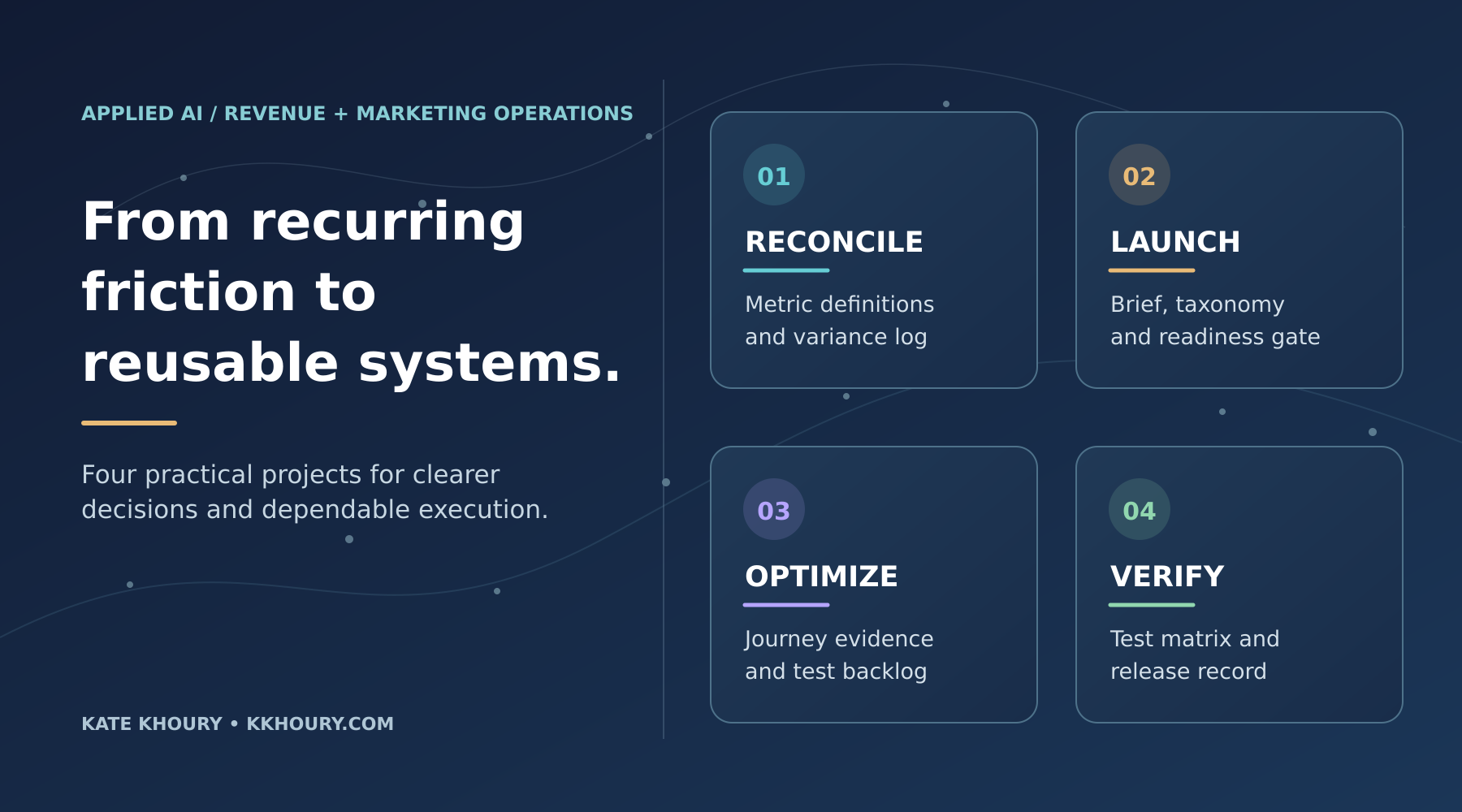
The Library of Clarity / Applied AI & Operations
From reporting discrepancies to launch checks and website friction, the value comes from making the work repeatable.


When I use AI at work, I usually begin with an operating problem: two teams cannot explain a number, a campaign is assembled through scattered handoffs, a website journey has visible friction, or a release depends on someone remembering every check. The goal is a useful artifact that a team can run, review, and improve.
AI helps me organize inputs, draft a first pass of logic or documentation, explore edge cases, and move between technical detail and business language. I still define the decision, verify the evidence, protect sensitive information, and own the final recommendation. Here are four project ideas drawn from the kinds of work I do in Revenue Operations, Marketing Operations, and digital experience.


01 / Build a reporting reconciliation kit
When CRM, campaign, and Finance reports disagree, the first deliverable should be an explanation of the difference.
Build. Create a metric dictionary, a source-of-truth matrix, a discrepancy log, and a short QA checklist. Record the reporting cutoff, filters, grain, currency, attribution rule, and owner for each measure.
Where AI helps. AI can organize approved definitions, draft comparison queries from a sanitized schema, and group discrepancies into likely causes such as timing, field mapping, duplicates, or inclusion rules.
Why it matters. The team can resolve a variance without restarting the investigation each month. Leaders see what each number means and which source answers which decision.
Make it yours. Start with one disputed KPI and two systems. Reproduce the variance, log its cause, and assign an owner before expanding the kit.
02 / Turn campaign launch into a governed workflow
A strong campaign needs a traceable path from objective and audience to launch approval and results.
Build. Make a compact intake brief, naming and UTM rules, a handoff map, a launch readiness checklist, and a results tracker tied to the original objective.
Where AI helps. AI can convert the approved brief into task drafts, suggest missing dependencies, check taxonomy against a rule set, and prepare a retrospective from verified launch and performance notes.
Why it matters. Owners and approval points become visible. Tracking, forms, exclusions, routing, and follow-up are checked before spend and traffic arrive.
Make it yours. Use one channel and one campaign first. Add a go/no-go gate with named approvers, then revise the checklist after the first launch.
03 / Create a website UX and CRO opportunity map
A page review becomes more useful when observations lead to specific hypotheses and measurable changes.
Build. Combine journey notes, analytics, form behavior, support themes, and a content review into an evidence table. Prioritize a small backlog by user friction, business impact, effort, and measurement readiness.
Where AI helps. AI can summarize anonymized observations, cluster repeated friction points, draft alternative copy or layout hypotheses, and surface missing accessibility or instrumentation checks.
Why it matters. The team has a reason for each change and a way to learn whether it helped. Design, content, analytics, and lifecycle messaging can be reviewed as one journey.
Make it yours. Pick one high-traffic page and one desired action. Define the current baseline, make one focused change, and assess the result alongside qualitative feedback.
04 / Make operational QA reusable
The same failure modes recur in CRM routing, forms, automations, and website releases unless the checks survive the project.
Build. Create a test matrix with the change, expected behavior, test record or path, owner, result, exception, and rollback action. Keep it alongside the release notes.
Where AI helps. AI can turn requirements into test cases, propose boundary conditions, compare expected and observed outputs, and draft concise release documentation.
Why it matters. A reviewer can see what was tested, what failed, and who accepted the remaining risk. Each incident becomes a regression check for the next release.
Make it yours. Begin with a workflow that has caused a real issue. Test its normal path and two edge cases using synthetic records, then add the checks to the next release.
Start with the work that keeps repeating
Choose a problem your team has to solve more than once. Capture the inputs, decision rules, owner, tests, and output in a format someone else can use. Then let AI help draft, inspect, and maintain the parts that benefit from speed—while people validate the evidence and decide what changes.
That is how I use AI in practice: to turn individual effort into clearer, more dependable ways of working. Explore my work portfolio for related projects, or get in touch if you are building a stronger operating system for your team.