The Library of Clarity · Leadership & Organizational Systems
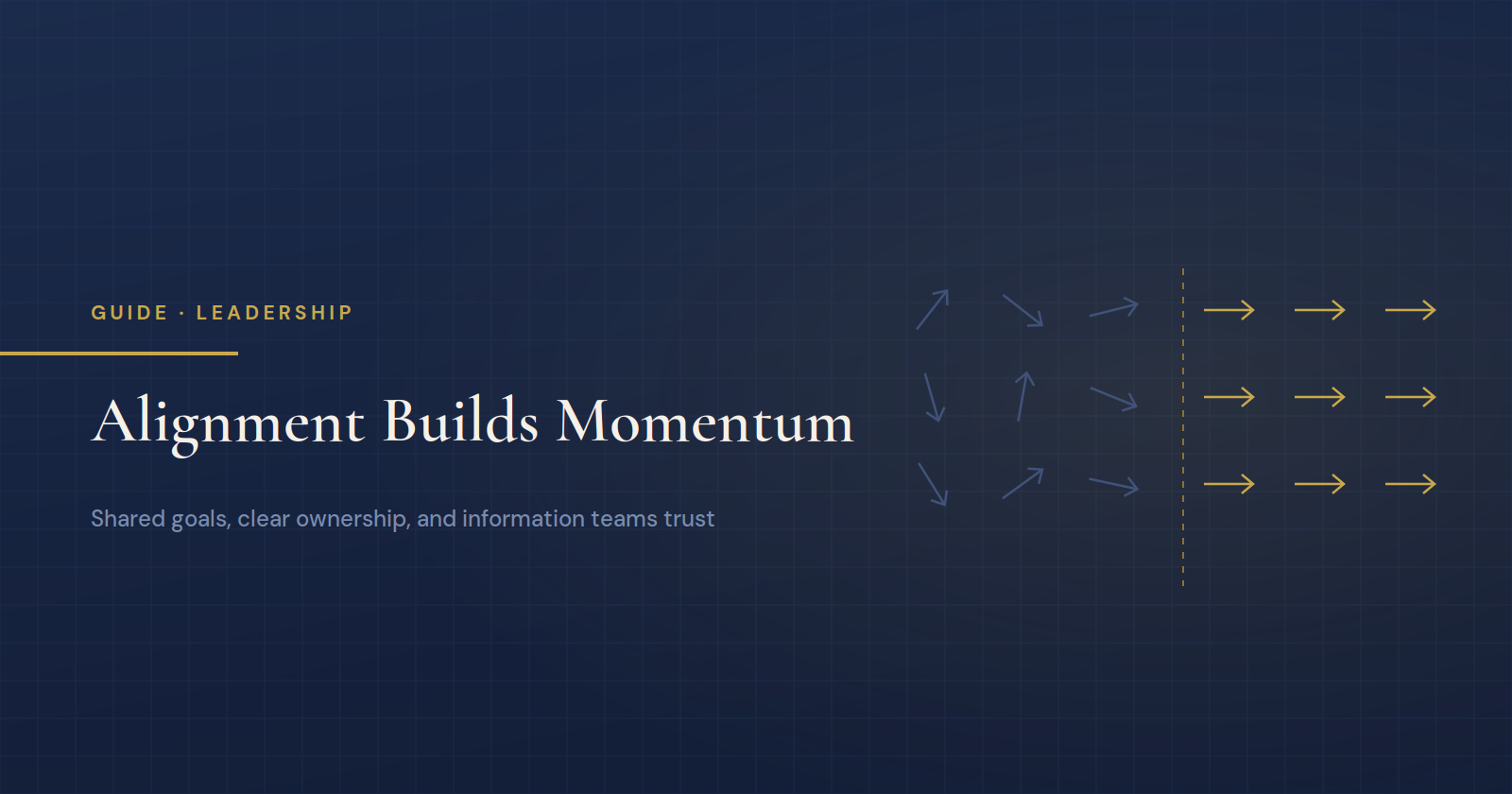
Alignment Builds Momentum.
How shared goals, clear ownership, trusted data, scalable documentation, and consistent communication turn strategy into coordinated execution.
Technology scales processes. Alignment scales organizations. One of the biggest competitive advantages a company can have is not another platform or dashboard—it is the ability to move together.
Throughout my career in Revenue Operations, Marketing Operations, and Data Management, I have seen organizations invest heavily in technology while teams continue operating in silos. Marketing launches campaigns Sales does not know about. Product ships features Customer Success is not prepared to support. Leadership receives three reports showing three different versions of the truth.
The root problem is rarely technology. It is alignment.
Why alignment matters
Alignment creates clarity across every function in the business. When teams understand company priorities, individual ownership, success metrics, and decision-making processes, work moves faster with significantly less friction.
Without alignment, organizations experience duplicated work, conflicting priorities, inconsistent reporting, and slower decision-making.
The five pillars of organizational alignment
1: Shared goals
Every department should understand how its objectives contribute to company-wide outcomes—not only its own KPIs. Shared goals create collaboration instead of competition.
2: Clear ownership
People should never wonder who owns a decision, who approves it, or who is responsible after launch. Clearly defined ownership reduces delays and prevents projects from falling between departments.
3: A single source of truth
Different dashboards should not produce different answers. Reliable data requires consistent definitions, standardized reporting, trusted systems, and documented governance.
4: Documentation that scales
Processes should not exist only in someone’s memory. Well-documented SOPs, workflows, naming conventions, and operating procedures create consistency while reducing onboarding time and operational risk.
5: Consistent communication
Alignment is not created during annual planning. It is reinforced through weekly operating reviews, cross-functional planning, shared dashboards, and transparent project updates. Small conversations prevent expensive problems.
“When everyone trusts the data, discussions shift from debating numbers to making decisions.”
The role of Revenue Operations
Revenue Operations sits at the intersection of people, processes, technology, and data. A strong RevOps function does not simply implement software. It connects Marketing, Sales, Customer Success, Operations, and Leadership into one operating system where information flows naturally across the organization.
The result is better forecasting, faster execution, cleaner data, stronger customer experiences, and more confident decision-making.
Alignment compounds
Alignment creates momentum. Clear communication improves execution. Better execution improves trust. Trust encourages collaboration. Collaboration produces better outcomes. Those outcomes create even greater alignment.
Organizations rarely become high-performing through one transformational initiative. They improve through hundreds of small operational decisions that make it easier for people to work together every day.
Key takeaways
The strongest organizations consistently invest in:
- Shared goals across departments
- Clear ownership and accountability
- A trusted single source of truth
- Scalable documentation
- Predictable communication rhythms
These principles reduce friction, improve decision-making, and create the operational foundation that allows businesses to grow.
Sustainable growth requires alignment
Sustainable growth is not created by adding more tools. It is built by connecting people, processes, and data into a system that enables better decisions and consistent execution. That is the foundation I strive to build as a Revenue Operations leader.
About Kate Khoury
Kate helps organizations build clarity across Revenue Operations, Marketing Operations, Analytics, AI, and Digital Strategy. She specializes in designing systems that reduce complexity, improve decision-making, and create measurable business impact.
“I help organizations create lasting clarity, stronger alignment, and systems that continue delivering value as they grow.”